What is Endodontics?
Endo” is the Greek word for “inside” and “odont” is Greek for “tooth.” Endodo
ntic treatment is treatment of the inside of the tooth.
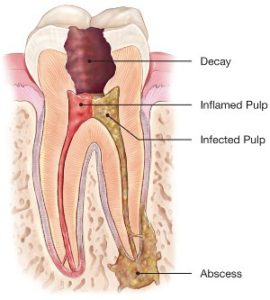
To understand endodontic treatment, it helps to know something about the anatomy of the tooth. Underneath the hard, translucent enamel and the less rigid, tubular structure called dentin, is soft-tissue called the pulp. The pulp contains blood vessels, nerves and connective tissue, from which both the dentin and the enamel are derived during early development.
The pulp spans the entire tooth, from the crown to the tip(apex) of the roots. Hence, inflammation, infection, and subsequent deterioration of the pulp can not only result in pain, but can also trigger breakdown of the surrounding bone and soft tissue (abscess), with which the pulp is in communication via an opening at the apex.
The most common reasons for inflammation or infection are deep cavities (caries), repeated dental procedures, cracks or fractures in a tooth.
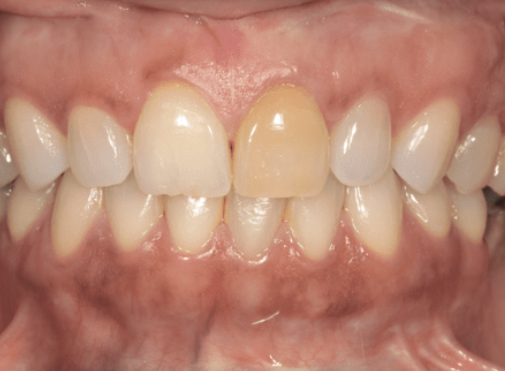
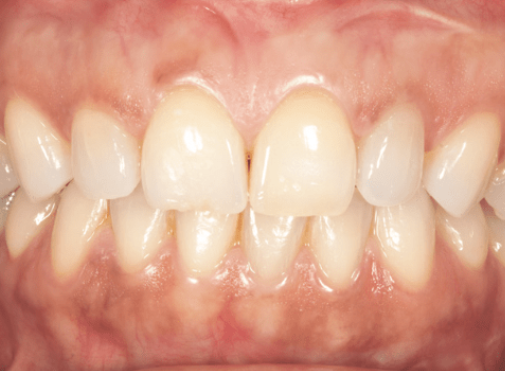
Trauma, and even orthodontic movement (albeit very infrequently) can also cause inflammation and often shows up as discoloration of the tooth.
The remedy for these conditions is to remove the affected pulp. A fully mature tooth can survive without the pulp.
Endodontic Treatment
Endodontic treatment becomes necessary when the pulp (internal soft tissue of the tooth) becomes inflamed or infected.
Endodontic treatment can often be performed in one visit but in some cases two or more visits may give a better chance of success.
Local Anesthetic is administered and a small, flexible sheet called a “dental dam” is placed to isolate the tooth and keep it clean and to also to protect the patient’s throat.
An small opening is made in the crown of the tooth to access the pulp chamber.
Very small instruments are used to clean out the pulp from the pulp chamber and root canal space(s) and to shape the space(s) for filling.
An inert filling material (usually a rubber-like substance called gutta-percha) is placed with adhesive cement to close the root canal spaces.
In most cases, a temporary filling is placed to close the access opening, after which you will return to your dentist to have a core buildup or post & core buildup, and often a crown or other restoration placed on the tooth to protect and restore it to full function. The sooner you return to your dentist, the better.
Endodontic Re-treatment
Occasionally a tooth that has undergone endodontic treatment fails to heal or pain continues despite therapy. Although rare, sometimes a tooth initially responds to root canal therapy but becomes painful or diseased months or years later.
When either of these situations occurs, the tooth often can be maintained with a second endodontic treatment (re-treatment). The procedure for endodontic re-treatment mirrors that of the root canal therapy your tooth originally received.
However, the difference with re-treatment is the need for the doctor to remove the dental materials from the first root canal therapy before cleaning out the tooth. Re-treatment also may involve addressing previously un-detected root canal spaces that may have contributed the reinfection.
Apical Surgery "Apicoectomy"
Occasionally a tooth has undergone multiple endodontic treatments and has still not responded favorably to the treatment.
Another scenario is that canals have become calcified, meaning deposits in the tooth make the canals smaller. If a tooth becomes too calcified, sometimes root canal treatment cannot access portions of the canal space.
In the cases of failed treatment or calcified canals, a surgical approach may be indicated.
During an apical surgery, the gums are peeled back to reveal the bone. A small opening is created through the bone to reveal the tip of the tooth. In some cases, an opening may already be present as a result of infection.
Next, a few millimeters of the root tip are sectioned to remove infected material and to access the canal from the bottom. Once the canal has been sealed from the bottom, several small stitches are placed.
Internal Bleaching
Pulp Cap "Pulpotomy"
Sometimes deep cavities (caries) advances very close to the pulp or a tooth chips and exposes the pulp in the non-fully developed teeth of younger patients.
If these teeth are asymptomatic and respond normally to endodontic testing, then it may be preferable to avoid complete removal of the pulp tissue. Instead a biocompatible material can be placed close-to or directly-contacting the pulp for the goal of continued root development (apexogenesis).
These teeth must be closely monitored, because pain, infection, and/or discoloration may eventually develop.
Trauma Considerations
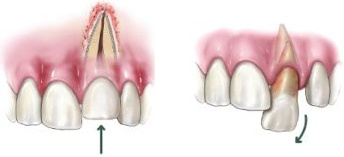
Traumatic injury to a tooth can occur after a fall, an accident, or playing sports. The severity of the injury can range from chipped enamel to completely knocking out your tooth. At the very least, endodontic evaluation will be in order because of potential damage to the pulp.
In the case where a tooth is not completely out of the socket, but is pushed out of position (luxation) and alignment, it may be of benefit to consult with an orthodontist as well.
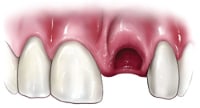
If the tooth is completely knocked out of the socket, the nutrition to both the pulp and the ligament that surrounds the tooth will be disrupted. The longer the delay to replant the tooth, the greater likelihood of permanent damage to the ligament, which can result in the tooth fusing to the bone (ankylosis) and/or the surrounding bone attacking the tooth (invasive resorption).
Re-evaluation